
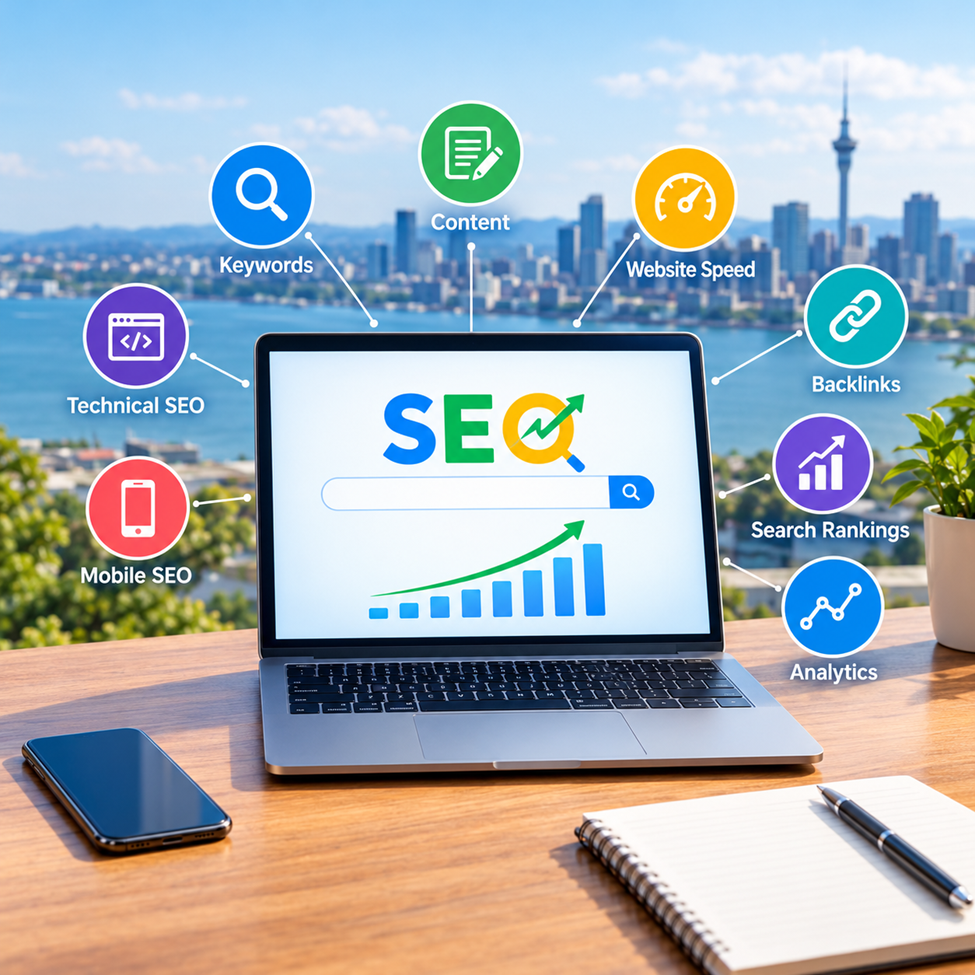
A website needs more than attractive design to perform well in search results. It must provide useful information, load efficiently, work across devices, and help visitors find what they need. At Web8, we focus on practical SEO strategies that help businesses improve website performance, strengthen search visibility, and create a better user experience. Implementing the right SEO Improvements can make your website easier for search engines to understand and more useful for potential customers.
For New Zealand businesses, SEO helps connect products and services with relevant searches. Reviewing these 15 areas can improve website visibility, user experience, and opportunities to generate enquiries.
15 Website SEO Improvements to Consider
1. Conduct Comprehensive Keyword Research
Keyword research helps you understand what potential customers search for before choosing a product or service. Instead of targeting broad terms alone, identify relevant search phrases that reflect different stages of the customer journey.
Consider:
- The services and products your business offers.
- Questions customers commonly ask.
- Local searches relevant to your service areas.
- Informational and transactional search intent.
Use these findings to guide your page topics, headings, and content. Choose keywords that match the purpose of each page rather than forcing the same phrase into every section.
2. Improve Page Titles and Meta Descriptions
Page titles help search engines and users understand what a page covers. Meta descriptions provide a summary that can encourage relevant users to visit your website.
Write unique, descriptive titles that include the primary keyword naturally. Keep them concise and make each description accurately reflect the page’s content.
Avoid duplicate metadata across important pages. Clear, relevant descriptions can improve how your pages appear in search results, although search engines may generate different snippets.
3. Create Helpful, Search-Focused Content
Useful content answers questions, explains services, and helps readers make informed decisions. Pages written only to include keywords may fail to satisfy visitors.
Review your existing content and identify areas that need clearer explanations, additional detail, or updated information. Include practical examples and answer the questions customers are likely to ask.
Web8’s SEO services focus on content and website optimisation to support search visibility and user experience.
4. Optimise Heading Structure
Headings organise information into clear sections, making content easier to scan and understand. Use one clear main heading for the page and relevant subheadings to organise supporting topics.
A logical heading structure should:
- Explain what each section covers.
- Include relevant keywords where they fit naturally.
- Help readers locate information quickly.
- Avoid repeating headings simply for keyword placement.
Clear headings can also help answer-focused content communicate information more effectively.
5. Improve Website Loading Speed
Slow-loading pages can frustrate visitors and make it harder for them to complete important actions. Review page performance, particularly on mobile devices, and address issues that delay the main content from appearing.
Useful improvements include compressing large images, reducing unnecessary scripts, enabling browser caching where appropriate, and reviewing hosting performance.
Use performance testing tools to identify the most significant issues before making changes. Focus on measurable improvements rather than adding technical features that do not benefit visitors.
6. Make Your Website Mobile-Friendly
Many people research businesses and services on smartphones. Your website should display clearly and remain easy to use on smaller screens.
Check that text is readable, navigation works properly, buttons are easy to tap, and forms can be completed without unnecessary effort. Ensure important content is available on mobile rather than hidden or removed.
A mobile-friendly website supports a consistent experience and helps visitors move from researching a service to contacting your business.
7. Improve Website Navigation
Clear navigation helps users and search engines understand how your website is organised. Visitors should be able to find essential pages without working through confusing menus.
Group related services logically and use descriptive navigation labels. Important pages should be accessible through the main menu or relevant internal links.
For larger websites, a logical hierarchy can also help search engines discover important pages and understand how different sections relate to one another.
8. Strengthen Internal Linking
Internal links connect related pages within your website. They help visitors discover useful information and provide context about the relationship between different topics.
For example, a blog discussing website performance can link naturally to a relevant SEO service page. A related article can also direct readers towards a more detailed guide.
Use descriptive anchor text that explains the destination. Check for broken internal links and avoid adding links that do not help the reader.
9. Optimise Images
Images contribute to user experience, but poorly optimised files can affect loading speed. Use appropriately sized images and compress them without noticeably reducing quality.
Add descriptive alternative text to meaningful images so their content can be understood by users who rely on assistive technology. Decorative images should be handled appropriately without unnecessary descriptions.
Use relevant file names and modern image formats where supported. Avoid adding keywords to image descriptions when they do not accurately describe the image.
10. Review Technical SEO Issues
Technical SEO helps search engines access, crawl, and understand website content. Problems such as blocked pages, incorrect redirects, broken links, and duplicate URLs can interfere with search visibility.
Review the following areas:
Technical area | What to check |
Indexing | Important pages can be indexed |
XML sitemap | Relevant canonical URLs are included |
Robots.txt | Important content is not accidentally blocked |
Redirects | Old URLs lead to appropriate destinations |
HTTPS | Pages use secure connections |
Canonical tags | Preferred versions of duplicate or similar pages are identified |
Broken links | Internal links lead to working destinations |
Prioritise problems that affect important pages or prevent search engines from accessing useful content.
11. Optimise URLs
Clear URLs help users understand what a page is about before opening it. Use short, descriptive addresses that reflect the page topic.
For example, a page about website SEO improvements could use /website-seo-improvements/ rather than a long URL containing unnecessary parameters.
Avoid changing established URLs without a clear reason. If a change is necessary, implement appropriate redirects and update internal links to reduce the risk of broken pages.
12. Strengthen Local SEO
Local SEO is particularly important for New Zealand businesses serving specific towns, cities, or regions. Accurate business details help customers identify where a company operates and how to contact it.
Keep your Google Business Profile information accurate, maintain consistent business details across relevant directories, and create useful location pages when they serve genuine customer needs.
Include service areas naturally in relevant content. Avoid creating multiple near-identical location pages that offer little additional value.
13. Add Structured Data Where Relevant
Structured data uses a recognised format to help search engines interpret information about a page or business. Depending on the website, suitable types may include Organisation, LocalBusiness, Article, BreadcrumbList, and relevant product or service-related markup.
Ensure the structured data matches the information visible on the page. Validate the implementation and correct errors that could affect eligibility for supported search features.
Structured data does not guarantee enhanced search results or AI citations, but accurate implementation can improve the clarity of information provided to search engines.
14. Optimise Content for AI Search and Direct Answers
Search behaviour increasingly includes conversational questions and AI-generated responses. Businesses can prepare their content by making important information clear, accurate, and easy to understand.
Start sections with direct answers where appropriate, then provide supporting explanations. Use descriptive headings, relevant FAQs, and consistent business information across your website.
Topical depth and clear explanations can support both traditional SEO and answer-focused discovery. Alongside traditional SEO, AEO services can help businesses structure their content to improve its suitability for AI-generated answers and recommendations.
No particular content format guarantees that an AI platform will cite or recommend a business. Prioritise usefulness, accuracy, and evidence of relevant expertise.
15. Monitor Performance and Update Your Website
SEO requires ongoing review because customer behaviour, competitors, and search results change over time. Track performance to understand which improvements are working and where further attention is needed.
Monitor:
- Organic clicks and impressions.
- Search queries and landing-page performance.
- Relevant keyword visibility.
- Leads, enquiries, and conversions.
- Technical issues and indexing changes.
- Engagement with important website pages.
Use Google Search Console and analytics data to identify opportunities. Update outdated information, improve underperforming content, and prioritise changes based on business goals rather than rankings alone.
How to Prioritise Website SEO Improvements
Not every website needs all 15 changes at once. Start with issues that affect important pages, prevent indexing, or create significant usability problems.
Priority | Recommended actions | Main objective |
High | Fix indexing errors, broken pages, and major mobile issues | Remove barriers to visibility and usability |
Medium | Improve titles, content, internal links, and page structure | Strengthen relevance and navigation |
Ongoing | Update content, monitor performance, and improve local and AI visibility | Support sustainable growth |
Your priorities should reflect the website’s current condition, competition, available resources, and conversion goals.
Conclusion
Effective SEO Improvements involve more than adding keywords to a website. They require a balanced approach to technical performance, content quality, navigation, internal linking, local visibility, and ongoing measurement.
For New Zealand businesses, consistent optimisation can help build a more accessible website, improve the relevance of organic traffic, and support long-term digital growth. Combining traditional SEO with clear, answer-focused content can also help your business prepare for changing search behaviour.
If you want to understand where your website can improve, Contact us at Web8 to discuss your SEO goals and explore practical ways to strengthen your online presence.
Frequently Asked Questions
Start by checking indexing issues, broken pages, mobile usability, page titles, and the quality of your most important content. These checks help identify barriers that may affect search visibility or user experience.
The time required varies according to competition, website condition, the type of changes made, and the search terms targeted. Some technical corrections may have an earlier impact, while broader improvements can take longer to produce measurable results.
SEO focuses on improving visibility in traditional search results. Answer Engine Optimisation (AEO) focuses on making information clear and accessible for direct answers and AI-driven search experiences. Both approaches can work together.
Businesses can maintain accurate Google Business Profile details, use relevant local keywords, create useful service-area content, earn genuine customer reviews, and keep their business information consistent across appropriate directories.
An SEO consultant plays an important role in identifying technical issues, analysing content opportunities, prioritising website improvements, and monitoring performance. Their expertise helps businesses implement effective SEO strategies, improve search visibility, and achieve sustainable organic growth.