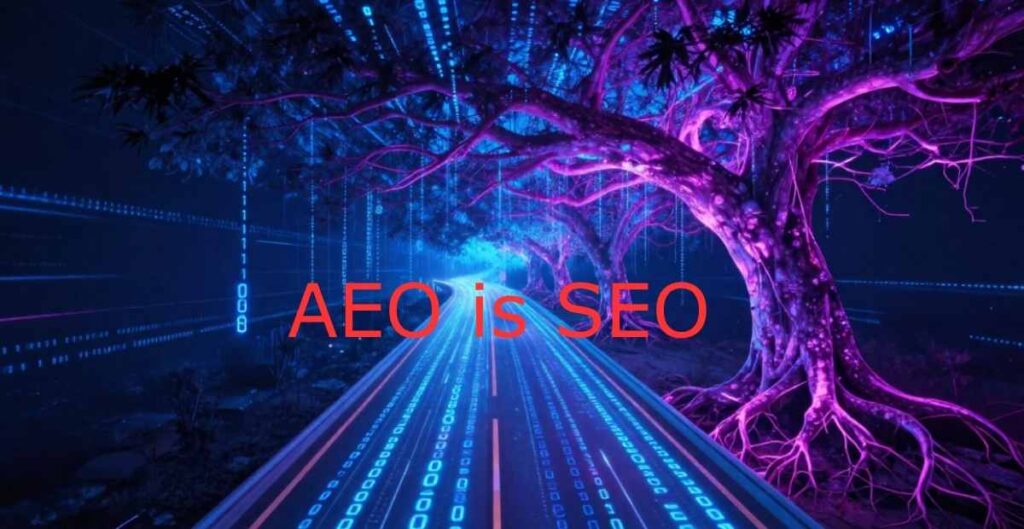
The Sky’s Not Falling: Why AEO is Sweet As, if Your SEO is Sorted.
If you’ve been keeping an eye on digital marketing trends lately, you’ve probably heard heaps of talk about AEO (Answer Engine Optimisation) and GEO (Generative Engine Optimisation).
The word on the street sounds pretty grim: ChatGPT, Google AI Overviews, and Perplexity are going to eat your organic traffic for breakfast. The old school ten blue links are dead. Panic accordingly.
But here at Web8, we reckon it pays to look at the data rather than get caught up in the drama. And the data tells a much brighter story.
If your website’s SEO is already in good shape, integrated, and built for real people, AEO is not a problem. In fact, it’s just traditional SEO with a slightly flashier vocabulary. Google even backed this up recently by confirming you don’t need a whole new playbook for AI Overviews; good old-fashioned SEO remains the primary way to get noticed by AI.
Why Good SEO is Already Doing the Heavy Lifting
AI engines don’t just whip up answers out of thin air. They are voracious readers. They crawl, index, and analyse the exact same web pages that traditional search engines do.
If your current SEO strategy focuses on what the user actually wants, fast loading speeds, clean site structure, and trustworthy info, you are already doing the hard yards.
Traditional SEO optimises for a click, while AEO optimises for a citation. But the raw material required for both is exactly the same: high-quality, structured, trusted content. If your website is a ghost town of thin content and keyword stuffing, then yeah, AI engines will ignore you. But if your SEO is working, you’re already sorted to win.
The Actual Hiccups AEO Causes (And How Web8 Fixes Them)
While AEO isn’t an “SEO killer,” it does shift the goalposts a bit. It introduces a few specific challenges that standard setups might not be ready for. Here are the three main issues we see, along with how we fix them:
1. The Rise of the “Zero-Click” Search
The Issue: AI engines love giving direct, conversational answers. If a user asks, “What is the standard size of a commercial garage door?” and Google’s AI Overview prints the exact dimensions on the spot, the user has no reason to click through to your website. Your organic traffic metrics take a bit of a hit.
The Fix: Shift your content focus toward deep-funnel, high-intent topics and multi-modal content. AI is great at summarising simple facts, but it struggles to replicate hands-on experience, proprietary tools, or nuanced decision-making. We optimise for queries where the user absolutely needs to click through (like interactive calculators, downloadable guides, or complex case studies).
2. The “Retrieval Gap” (Too Much Corporate Fluff)
The Issue: Traditional SEO sometimes let businesses get away with vague marketing jargon (think along the lines of “We offer synergistic, next-generation business solutions”). AI engines absolutely hate this. If someone asks an AI for a “cloud platform with SOC2 compliance and under $50 a month pricing,” and your website uses fluffy language instead of explicit data, the AI cannot confidently recommend you.
The Fix: Implement an “Answer-First” content layout. We structure high-value pages to feature direct, punchy, 40-to-60-word answers immediately following a question-based heading. We turn your product benefits into clear, factual, database-like text. If the AI can parse your data instantly, it will cite you as the source.
3. The Analytics and Attribution Fog
The Issue: Standard analytics tools (like GA4) are built to track direct clicks from a search engine results page. When a user discovers your brand because ChatGPT recommended you in a casual conversation, tracking that touchpoint is incredibly difficult. It usually shows up as “Direct” traffic, leaving marketers guessing what actually worked.
The Fix: Build a Brand Authority Moat and track your AI share-of-voice. We pivot focus toward Entity SEO, ensuring your brand name, location, and specialisation are clearly linked across the web via advanced Schema markup (JSON-LD). We also run regular prompt audits to see how the major AI models recommend your brand, treating AI visibility as a vital new KPI alongside traditional organic impressions.
The Web8 Takeaway: Fuel the Answer
| Traditional SEO Focus | Modern AEO / GEO Extension |
| Ranking for head keywords | Becoming the definitive, trusted entity |
| Writing to fill up a web page | Writing to fuel a clear answer |
| Optimising for the link click | Optimising for the trusted citation |
At the end of the day, AEO isn’t a brand-new sport; it’s just the same game being played on a slightly faster pitch. Instead of worrying about AI taking your traffic, look at it as an excellent way to amplify your brand’s authority.
If your technical SEO foundations are tight, your schema is clean, and your content genuinely answers the questions your customers are asking, you aren’t losing the AI revolution, you’re leading it.