
Is your business ready for Employee Ownership?
As the interest in Employee Ownership in Aotearoa New Zealand amongst NZ SME businesses owners and founders builds, a recurring conversation that comes up is how do I know if my business is ready for employee ownership?
Before you dive into legal structures, here are 4 quick strategic tests to reflect on to help you assess whether the timing and conditions are right for you.
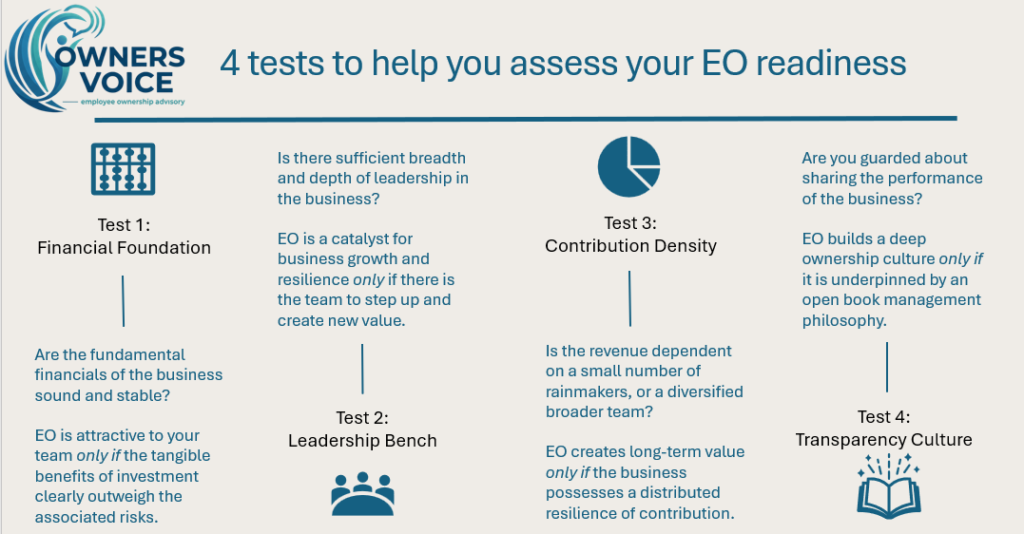
Test 1: Financial foundation: Are the fundamental financials of your business sound and stable? EO is attractive to your team only if the tangible benefits of investment clearly outweigh the associated risks.
For an EO model to be meaningful, there must be “skin in the game” that leads to real rewards. If margins are razor-thin or the business is in a turnaround phase, the timing or conditions may not be right for EO – the risk may outweigh the perceived benefit for your employees. However, if the foundation of your financials are stable, EO becomes a powerful engine to drive the future growth of your business.
Test 2: Leadership bench: Is there sufficient breadth and depth of leadership in the business? EO is a catalyst for business growth only if there is the team to step up and create new value.
An EO model should be a catalyst for growth, but it relies on a team with the potential to “step up” and create new value. If your leadership is concentrated in a small few, your EO model may lack the foundation to scale and create the value you wanted.
Test 3: Contribution density: Is the revenue of your business dependent on a small number of rainmakers, or a broader diversified team? EO creates long-term value only if the business possesses a distributed resilience of contribution to commercial performance
Where does value in your business derive from? If your revenue is tied to one or two “rainmakers,” the business lacks the distributed resilience needed for collective ownership. However, if there is a broad team sustaining a diverse client portfolio, you have the necessary “contribution density” to transition from a few key players to a team of owners.
Test 4: Transparency culture: Are you guarded about sharing the performance of the business? EO builds a deep ownership culture only if it is underpinned by an open book management philosophy.
Prospective employee-owners need to understand the risk/reward equation and how their daily output affects the bottom line. If your culture is built on information silos, your EO may fail. If you already foster a culture of trust where people understand the mechanics of profit and loss, you are ready to bridge the gap from “employee” to “owner.”
Assessing your readiness is simply the first step toward exploring Employee Ownership.
At Owners Voice, we specialise in helping Kiwi business owners and founders transition from theoretical interest to practical execution. Whether your business aced all four tests or you’ve identified areas that need strengthening, we are here to guide you through the strategic, cultural, and financial shifts required for success.
Let’s start a conversation today to explore how employee ownership can unlock the next chapter of growth for your business and your team.